Latest Updates from AM2026 Thailand
วันที่นำเข้าข้อมูล 26 ต.ค. 2569
วันที่ปรับปรุงข้อมูล 26 ต.ค. 2569
Thailand earns praise as ‘Finance Olympics’ concludes

Mohamed Al Hussaini, Khaled Mohamed Balama, Ajay Banga, and Kristalina Georgieva hold a 2029 IMF-WBG Annual Meeting Host Country Agreement. Source: am2026thailand.go.th/
BANGKOK, 17 Oct 2026: Thailand has earned international praise for hosting the 2026 IMF–World Bank Group Annual Meetings, using the global gathering to showcase its cultural heritage while calling for global partnerships to bring benefit to the people.
During her closing remarks, IMF Managing Director Kristalina Georgieva expressed her gratitude and admiration for Thailand, highlighting the host country’s exceptional hospitality, rich culture, and warm atmosphere. She singled out the exhibition honoring Her Majesty Queen Sirikit, The Queen Mother, while sharing her fondness for Thai cuisine and Thai silk.
According to Georgieva, Thailand is a dynamic nation with creative, adaptable citizens capable of navigating a rapidly changing global landscape. She expects the country to continue its ascent as its people adjust to a fast-moving world.
Finally, she thanked Thailand for bringing diverse groups of people together across several discussions, reanchoring the IMF’s core mission to the people it serves.
For his part, Deputy Prime Minister and Minister of Finance Ekniti Nitithanprapas expressed his gratitude, extending thanks to everyone involved, including event staff, security officers, logistics, and even the taxi drivers who demonstrated exceptional hospitality that has been the trademark of Thai culture.
According to the deputy premier, many delegates reached out to him and personally assured that they plan to return to Thailand, in a sign of the country’s exceptional performance as host country to what is seen as the “Finance Olympics.”
Thailand as a trusted connector ahead of “rough waters”

IMF Managing Director Kristalina Georgieva standing behind the podium on a stage at AM2026. Source: am2026thailand.go.th
BANGKOK, 17 Oct 2026: Delegates conclude a seventh day of the 2026 IMF–World Bank Group Annual Meetings having exchanged views on the most pressing challenges to economies around the world, with the rise of artificial intelligence and geopolitical fragmentation top of mind.
Despite the “rough waters” ahead, Thailand has stepped up to act as a “trusted connector” at the Annual Meetings in a world where multilateralism and a rules-based global order are under assault.
Higher growth on shaky ground
The IMF’s International Monetary and Financial Committee (IMFC) has warned that the global economy faces growing risks despite apparent resilience. IMF Managing Director Kristalina Georgieva observed widening economic divergence amid a limited number of growth drivers — namely, AI.
Thailand, for instance, is expected to benefit from AI-driven investment, leading the IMF to revise its growth forecast for Thailand to 2.1% for both 2026 and 2027. Regionally, the IMF has revised up its Asia-Pacific growth forecast to 4.8% for 2026 and 4.4% for 2027.
Georgieva nevertheless has called for sound economic policies and international cooperation to ensure the benefits of AI technologies are shared widely.
Saudi Finance Minister Mohammed Al-Jadaan, in his capacity as IMFC Chair, echoed Georgieva’s calls for credible fiscal plans, while urging secure energy supplies and freedom of navigation in apparent reference to tensions surrounding vital energy corridors contested in the Middle East.
The case for renewables
Despite higher growth forecasts for the Asia-Pacific, the region is considered the largest market for energy imports, with Southeast Asia projected to be responsible for 20% of global energy consumption growth by 2035. Disruptions to energy security threaten to stifle the region’s economic growth, particular as it ramps up the development of energy-intensive data centers.
During the forum, “Low Carbon Cities and Energy Security – Building System at Scale, Mobilizing Private Capital, Creating Jobs,” featuring Thai Deputy Prime Minister and Finance Minister Ekniti, World Bank Group President Ajay Banga, and Krungthai Bank CEO Payong Srivanich, panelists pushed for market-driven incentives to drive venture capital into green infrastructure. Thailand’s Ministry of Finance, in particular, supports carbon credits mechanisms through the Low Carbon Cities and Carbon Market Development Project (LCC).
The World Bank is providing a US$200 million credit facility to the Export-Import Bank of Thailand (EXIM Thailand) under the LCC Project to fund both clean energy and energy efficiency in the public sector, fueling the transition to a low-carbon society.
Ekniti advocated in favor of replacing broad-based energy subsidies with target assistance to preserve limited fiscal resources, while at the same time, accelerating the green transition.
At the Bangkok Dialogue Notes session, DPM Ekniti likened international cooperation to a crew rowing in unison through rough waters. And Georgieva, who had nothing but praise for Thailand in hosting the Annual Meetings, said the Kingdom showed what a welcoming spirit can achieve.
“Resilience” emerges as mantra in financial community

Prime Minister Anutin Charnvirakul giving speech at the 2026 IMF-World Bank Group Annual Meetings Plenary. Source: am2026thailand.go.th
BANGKOK, 16 Oct 2026: As the 2026 IMF–World Bank Group Annual Meetings wraps on its fifth day, 15,000 delegates of the global financial community retire to their hotel rooms with one word on their mind: resilience.
Trust is at a premium
During his address at the opening plenary session, Thai Prime Minister and Interior Minister Anutin Charnvirakul reflected on the profound shift of global architecture in the 35 years since Thailand’s last hosted the Annual Meetings in 1991. In an age of rapid transformation due to artificial intelligence, climate change, geopolitical dynamics, it is more important than ever to forge trusted relations and partnerships for mutual learning and cooperation.
Anutin voiced confidence that the discussions over the past week will lead to more resilient economies, expanded opportunities, practical skills development, and broader societal participation.
Making AI for all
On artificial intelligence, IMF Managing Director Kristalina Georgieva outlined four key requirements to ensure AI technology benefits the people:
1. Reliable digital and energy infrastructure;
2. Greater investment in digital skills;
3. AI adoption in essential sectors (e.g., agriculture, healthcare, education); and
4. Effective regulations and ethical safeguards
Similar to the proliferation of mobile phones, Georgieva hoped that widespread access to AI technologies will allow people from all walks of life to reap the benefit in their life and work.
Jobs, jobs, jobs
Amid concerns of massive job displacement, World Bank Group President Ajay Banga has urged policymakers to optimize resources for job creation. He noted that over the next 10–15 years, an estimated 1.2 billion young adults will enter the workforce in developing nations. However, only 400 million jobs are expected to become available during that same period.
Therefore, it is crucial that each country invests strategically for their development needs, employing a combination of public financing, private investment, philanthropy, and technology.
Thailand empowers with cultural heritage and digital skills

Source: am2026thailand.go.th
BANGKOK, 15 Oct 2026: Thailand has taken the opportunity to platform a vision of a world that empowers people through their cultural heritage alongside digital & AI skills training.
The case for cultural diplomacy
As Thai popular culture continues to find international audiences and influence the global zeitgeist, Bangkok has strategically used its spotlight as host of 2026 IMF–World Bank Group Annual Meetings (AM2026 Thailand) to share the rich tapestry of its cultural heritage.
In recent years, one of the country’s foremost cultural ambassadors and pioneers has been Her Royal Highness Princess Sirivannavari Nariratana Rajakanya. During CNN’s “Global Perspectives: In Bangkok 2026” organized at The Ritz-Carlton, Bangkok alongside AM2026 Thailand, Her Royal Highness made an appearance at the invitation of CNN International President Ellana Lee. She attended two panel discussions, namely “Fabric of the Nation” and “Cities That Win the Future.”
During the first session, featuring Asst. Prof. Dr. Anucha Thirakanont, Director of the Sustainable Arts and Crafts Institute of Thailand (SACIT), and Vogue Thailand Editor-in-Chief Kullawit Loasukri, the Princess was honored for her contributions to the preservation of Thai textiles and local craftsmanship through their integration with modern fashion. Her Royal Highness has also been instrumental in efforts to secure UNESCO recognition of Chud Thai, or traditional Thai dress, as an intangible cultural heritage.
Other Thai cultural aspects abound on the sidelines of AM2026 Thailand. An exhibition entitled, “Thai Pavilion: The Royal Legacy — Empowering People, Building Resilience,” showcased the royal duties and initiatives of King Rama IX, including his theory of self-reliance known as the Sufficiency Economy Philosophy. Meanwhile, the Thai Fight exhibit highlighted Thailand’s martial art, Muay Thai, featuring traditional robe-bound or Kard Chuek boxing, the humble Wai Kru ceremony, and live demonstrations.
AI and energy anxieties in the room
As world leaders and policymakers assemble in Bangkok, the drumbeat of geopolitical instability and economic uncertainty can be felt in every conversation.
“Yes, growth has been resilient. But this resilience is on a fragile foundation,” said IMF Managing Director Kristalina Georgieva during the “Debate on the Global Economy: Forging Resilient and Dynamic Economies for the Future.” Not only has economic growth been uneven, but it appears concentrated in a small group of economies due to enthusiasm surrounding artificial intelligence. Conversely, the IMF has downgraded its outlook for several economies impacted by war, hobbled by energy insecurity, and left out of the AI supply chain.
Like many Asian countries, Thailand is both a major energy importer and a key part of the AI supply chain.
“Thailand is like a small boat facing many storms,” said Deputy Prime Minister and Finance Minister Ekniti Nitithanprapas. According to him, there are four storms:
1. rising energy prices, and consequently, a rising cost of living, given that Thailand is a major oil importer;
2. geoeconomic fragmentation, which has produced both winners and losers of more diversified supply chains;
3. rising bond yields and interest rates, despite Thailand’s efforts to maintain fiscal discipline; and
4. the rise of AI, which has benefited Thailand as a part of its supply chain.
Ekniti underlined the importance of strong fiscal discipline and macroeconomic stability, while seeking structural reforms and to turn “shocks into opportunities,” lest they create a divergence in the economy for low-income earners and small businesses.
“We need to support [low-income earners and SMEs] to make transitions.” Ekniti said. “Building resilience is to support them to absorb the shocks and also to accelerate the transition to help them deal with bigger storms coming.”
Anti-fraud blueprint unveiled at AM2026 in Bangkok

Source: AM2026Thailand.go.th
BANGKOK, 14 Oct 2026: The Thai government has advanced international cooperation against digital financial crime while promoting investment in emerging economies, as the 2026 IMF-World Bank Group Annual Meetings entered their third day with a focus on financial security, economic resilience, and sustainable growth.
A key development was the launch of the Bangkok Blueprint for Fraud-Resilient Financial Services, jointly developed by Thailand’s Ministry of Finance, the Bank of Thailand (BOT), the International Monetary Fund (IMF), and the World Bank Group (WBG). The framework aims to help countries strengthen their responses to increasingly sophisticated financial scams that exploit interconnected banking systems and online platforms to move illicit funds across borders.
A coordinated response to financial fraud
The blueprint sets out 12 key policy considerations covering national strategies, legislation, regulatory oversight, suspicious-transaction detection, incident response, consumer protection, and recovery from financial losses.
Deputy Prime Minister and Finance Minister Ekniti Nitithanprapas and BOT Governor Vitai Ratanakorn joined international financial leaders in presenting the initiative, which emphasizes cooperation among governments and financial institutions, as well as telecommunications providers and digital platforms.
The framework builds on Thailand’s domestic efforts to tackle mule accounts while strengthening mobile banking security and improving coordination among service providers. It also complements the government’s “Connect the Dots” initiative to integrate financial information across agencies, helping authorities trace suspicious transactions and identify illicit money flows.
The blueprint is a set of adaptable policy guidelines rather than a binding international agreement. Its central premise is that financial security can’t only rest on consumers, but requires that service providers and authorities improve both detection and information-sharing alongside their responses to fraud.
Mobilizing investment, preparing for change
Wednesday’s program also addressed the challenge of directing private capital towards emerging markets and job creation. A WBG discussion brought together President Ajay Banga and business leads to examine how investment can support employment and economic development.
At the FUTURE-READY ECONOMY 2026 forum, Prime Minister Anutin Charnvirakul and OECD Secretary-General Mathias Cormann called for capital allocation that strengthens competitiveness and develops human capabilities while supporting long-term resilience.
Anutin highlighted the importance of diversifying energy sourcing and supply chains, while Cormann stressed that artificial intelligence must be accompanied by skills development to translate productivity gains into broader economic benefits. Thailand’s ongoing OECD accession process also provides conditions for strengthening policy standards and institutions.
Connecting global priorities with Thailand
Additionally, Anutin opened CNN Global Perspectives: In Bangkok, bringing international leaders and business executives together to discuss economic and social change. Held alongside the annual meetings, the forum aims to promote skills development and strengthen links between Thai entrepreneurs, workers, and global markets.
“Thailand is prepared to work with partners to strengthen skills, introduce new knowledge, and connect Thai people and businesses with opportunities in regional and global markets,” he said.
Thailand also used the meetings to present its cultural talent. At an official welcome dinner at Government House on Wednesday evening, 16-year-old Thai singer Nene Royal, who recently won Season 21 of America’s Got Talent, performed for over 400 distinguished guests and international leaders.
As delegates gather in Bangkok through October 18th, the discussions highlight a common challenge of ensuring that financial investment and innovation deliver tangible gains while strengthening safeguards against emerging risks.
Thailand positions itself as “Trusted Connector” at IMF-World Bank Meetings

Deputy Prime Minister and Finance Minister Ekniti Nitithanprapas attends a panel discussion at the 2026 IMF–World Bank Annual Meetings.
Source: NBT World
BANGKOK, 13 Oct 2026: Thailand is seeking to present itself as a reliable link between economies amid growing global fragmentation, with foreign investment applications surging and private investment expanding as policymakers use the 2026 IMF-World Bank Group Annual Meetings to promote economic resilience and inclusive growth.
Deputy Prime Minister and Finance Minister Ekniti Nitithanprapas outlined the strategy at a high-level panel on Tuesday, October 13th, 2026, alongside Managing Director Kristalina Georgieva, World Bank Group President Ajay Banga, and Finnish Finance Minister Rika Purra.
Ekniti reported that foreign investment promotion applications in Thailand rose 47% in the first half of 2026, while private investment grew by more than 10% for two consecutive quarters. He argued that Thailand must adapt to a global business environment increasingly shaped by security and resilience, rather than cost and efficiency alone.
Building resilience as a “Trusted Connector”
Thailand has diversified its energy imports away from heavy reliance on the Middle East towards suppliers in West Africa and Latin America, Ekniti said, seeking to reduce exposure to geopolitical disruptions.
He also pointed to the relative stability of the Thai government bond yields as evidence of investor confidence, noting that 10-year yields had risen by 60 basis points over eight months, compared with a 120-basis-point increase in US Treasury yields over the same period.
The government’s “Trusted Connector” strategy aims to link larger and smaller economies through trade, investment, and regional cooperation, while promoting technology transfers and workforce development. Its Skill Bridge program connects businesses with universities to equip workers with skills for artificial intelligence and other emerging technologies.
Ekniti stressed that foreign investment should generate benefits beyond capital inflows by strengthening domestic capabilities and preparing Thai workers for higher-value industries.
Global leaders address economic fragmentation
The meetings’ second day featured discussions on preserving connectivity and sustaining inclusive growth amid geopolitical tensions. A separate seminar, entitled “Bangkok 1991–2026: Thailand’s Path to Resilient, Inclusive Growth,” examined lessons from Thailand’s economic transformation since it last hosted the annual meetings 35 years ago.
The IMF also presented its latest World Economic Outlook and Global Financial Stability Report, assessing global growth prospects and risks to financial markets. A World Bank Group session, meanwhile, explored how data-driven financial innovation could expand access to credit for micro, small, and medium-sized enterprises, supporting business development and employment.
Bringing global benefits to local communities
Thailand is also using the gathering to showcase its cultural identity and distribute some of the benefits of hosting beyond Bangkok. More than 37 communities nationwide contributed textiles used to decorate meeting rooms, connecting local craftsmanship with an international economic forum.
Tourism and Sports Minister Surasak Phancharoenworakul said cultural activities at the meetings offered an opportunity to introduce international delegates to Thailand’s tourism attractions. He also said the Tourism Authority of Thailand (TAT) has organized major events to stimulate tourism.
“We remain confident that this year’s figures will be comparable to last year’s, despite the challenges posed by conflicts, fuel prices, and the global economic situation,” he said. “Having successfully navigated the early part of the year and maintained momentum up to this point, we are confident that we can accelerate activity in the final months to bring the figures close to our initial projections.”
As the meetings continue through October 18th, Thailand faces the task of translating international attention and investment interest into lasting gains in productivity and employment, as well as overall economic resilience.
IMF-World Bank Meetings kick off in Bangkok with AI and inclusive growth in spotlight
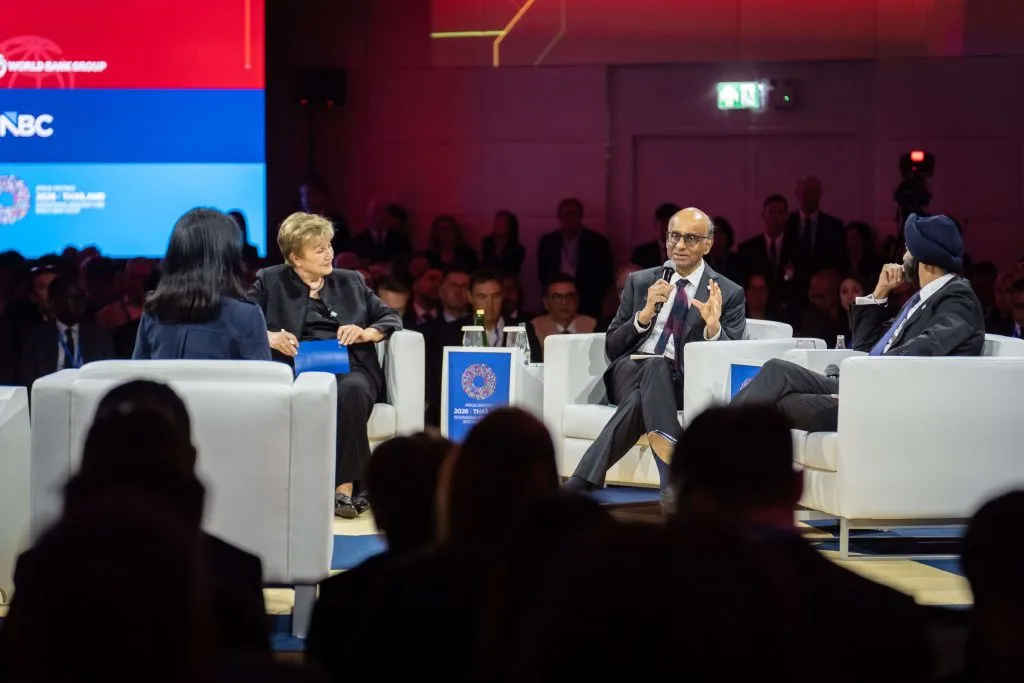
Left: IMF Managing Director Kristalina Georgieva. Middle: Singapore President Tharman Shanmugaratnam. Right: World Bank Group President Ajay Banga. Source: www.am2026thailand.go.th
BANGKOK, 12 Oct 2026: The 2026 IMF-World Bank Group Annual Meetings opened in Bangkok on Monday, October 12th, 2026, with a focus on how artificial intelligence can drive economic growth and create jobs in developing economies, as policymakers grapple with tech disruptions, demographic shifts, and mounting global economic pressures.
More than 15,000 delegates from 191 countries are gathering at the Queen Sirikit National Convention Center for the meetings, which run through October 18th. The event marks Thailand’s first time hosting the annual meetings in 35 years, bringing global financial leaders together at a time when economic resilience and international cooperation face growing challenges.
Alongside policy discussions, Thai Prime Minister Anutin Charnvirakul presided over the opening of Thailand’s pavilion. The pavilion’s exhibition, “The Royal Legacy: Empowering People, Building Resilience,” showcases seven decades of royal development initiatives built around community-led solutions, nature-based approaches, and resilience to economic and environmental shocks.
Small AI offers opportunities for developing economies
The opening “Small AI: More and Better Jobs” forum explored how affordable, purpose-built AI could improve productivity and expand employment without requiring costly computing infrastructure associated with large AI models.
World Bank Group President Ajay Banga and Singapore President Tharman Shanmugaratnam emphasized the potential for targeted AI applications in agriculture, healthcare, and education, particularly in emerging markets where access to technology remains uneven.
Deputy Prime Minister and Finance Minister Ekniti Nitithanprapas outlined plans to integrate the “Nok Krajib” AI assistant into government mobile wallet applications, supporting nearly one million small merchants in managing their businesses. He also highlights skills-development programs designed to connect major tech investments with workforce training
The discussion underscored the importance of ensuring that technological advances translate into productive employment instead of deepening disparities. Tharman warned that economic growth alone doesn’t guarantee sufficient job creation, calling for closer public-private cooperation to help graduates enter the workforce and for education systems to place greater emphasis on practical skills and workplace experience.
Closing the skills gap
At a separate Youth Dialogue moderated by IMF First Deputy Managing Director Dan Katz, participants examined how AI could help younger generations navigate a rapidly changing labor market.
Aukrit Unahalekhaka, co-founder and chief executive of Thai agritech company Thara Green, said smartphone-based AI tools could substantially expand farmers’ productive capacity. With farmers accounting for roughly a third of Thailand’s population, he said accessible technology could enable individual farmers to manage land more efficiently, potentially increasing the area they oversee from 10 to 40 acres.
Sarah Rauzana, chairperson of the ASEAN Youth Organization, highlighted the gap between young people’s enthusiasm for AI and the digital skills employers increasingly demand. She pointed to the AI Ready ASEAN initiative, which has reached over 350,00 young people and 500 educational institutions.
Balancing innovation and growth
The meetings also take place against a challenging global backdrop, with geopolitical tensions and energy market pressures as well as public debt and widening inequalities threatening growth prospects.
The discussions on AI reflect a broader question facing policymakers of how to harness tech investments while ensuring the benefits reach smaller businesses, vulnerable workers, and developing economies.
Juti Krairiksh, a Phitsanulok MP from the Bhumjaithai Party and chairman of the House of Representatives Committee on Finance, Fiscal Policy, Financial Institutions and Financial Markets, said hosting the IMF-World Bank Meetings reflects Thailand’s readiness and credibility on the global stage. “Trust is earned, cannot be bought,” he said. “Stability is the backbone of effective economic policy.”
As delegates continue their discussions this week, the challenge will be translating these priorities into practical policies that sustain growth while expanding opportunities and strengthening international economic cooperation.

Thailand Trade and Economic Office (Taipei)
| เวลาทำการ |
วันจันทร์ - ศุกร์ | 9:00-12:00, 14:00-17:00 |
|
| 🕿 | บริการคนไทย | (8862) 2775 2211 |
| Thai Visa | (8862) 2773 1100 | |
| 🖷 | Fax | (8862) 2740-3300 |
| 🖅 | General Affairs | [email protected] |
| บริการคนไทย | [email protected] | |
| Thai Visa | [email protected] | |